Northstar Mobility Group — Synthetic Pilot
This is a fully fictional, reproducible SAP S/4HANA transformation scenario in the public Martenweave Core repository. Northstar Mobility Group, its people, systems, identifiers, and rows are invented for product evaluation. Every participant address uses example.com; the scenario contains no client or SAP production data.
Core source: <https://github.com/metalhatscats/martenweave-core/tree/main/examples/northstar_mobility_pilot>
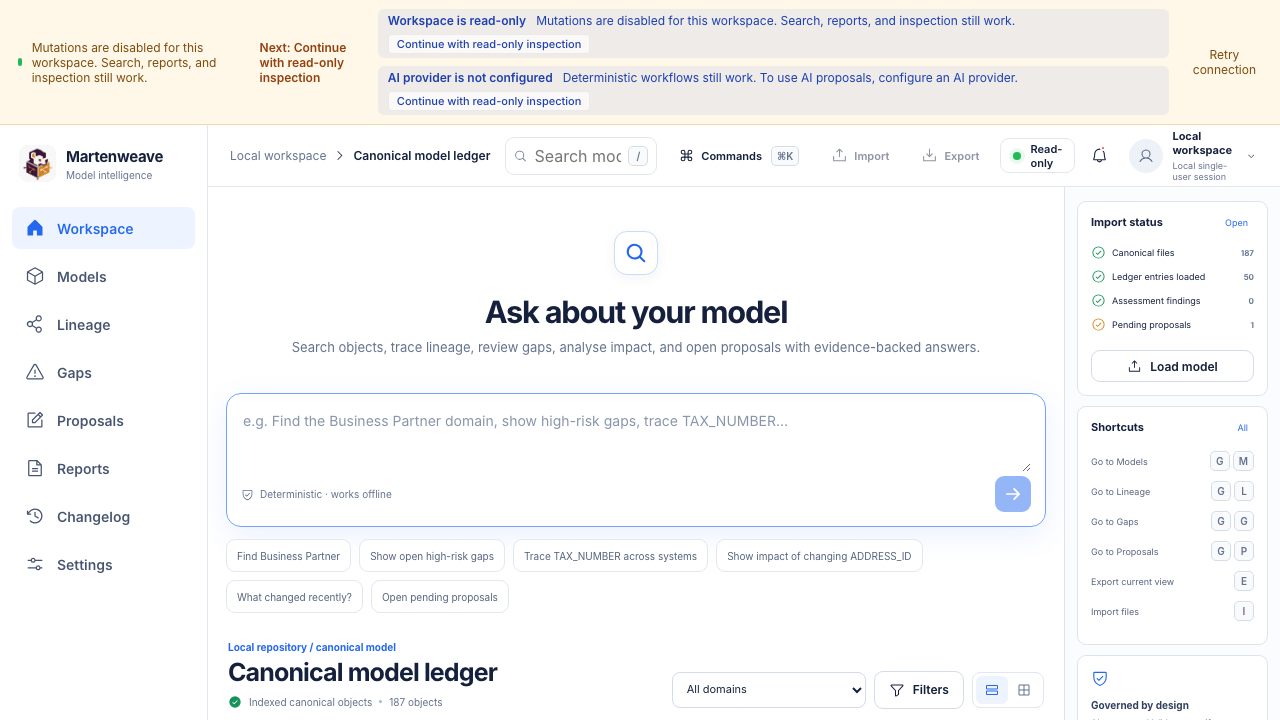
*Captured locally from martenweave workbench --repo examples/northstar_mobility_pilot after building the index. The Workbench is a local inspection and controlled-review surface; it does not write to SAP or apply changes automatically.*
What the pilot contains
The model has seven connected domains: Business Partner and Customer, Supplier, Material, Sales, Procurement, Logistics, and Finance. It connects Northstar CRM, Voyager ERP, Freightlink TMS, and LedgerPro FI to SAP S/4HANA field endpoints including BUT000, KNVV, LFA1, LFB1, MARA, VBAK, EKKO, LIPS, BKPF, and BSEG.
Its fictional roles are a migration lead, solution architect, customer and supplier data stewards, order-to-cash process owner, integration developer, and governance reviewer. Canonical files include owners, evidence, decisions, issues, value lists, mappings, validation rules, relationships, a pending high-risk PatchProposal, and an approved ChangeRequest that remains reviewable rather than executable by default.
Deliberate findings
The model itself remains valid: the verified run has 200 canonical objects, zero validation errors, and 13 intentional warnings. A freight-status interface slice (Interface, InterfaceEndpoint operations, MessageType, and SchemaNode objects) connects the fictional Freightlink TMS to the logistics domain. The synthetic extracts expose delivery risks through gap and readiness workflows instead of corrupting canonical truth:
- a sales-order extract has
order_totalrather than the mappednet_value; - material records contain unmapped type codes;
- customer records include duplicate business keys;
- two legacy credit-limit mappings conflict at
KNVV-KLIMK; - Logistics intentionally has no owner; and
- the open high-risk proposal blocks readiness until a human review.
The deterministic pilot run reports 61 gaps. The readiness command returns not ready because active_object_missing_owner and high_risk_unapproved_proposal are both active. Shared payment terms trace across Supplier, Procurement, and Finance (71 affected objects); shared customer credit limit reaches Customer, Sales, and Finance (55 affected objects). These are generated findings from the example, not claims about a customer programme.
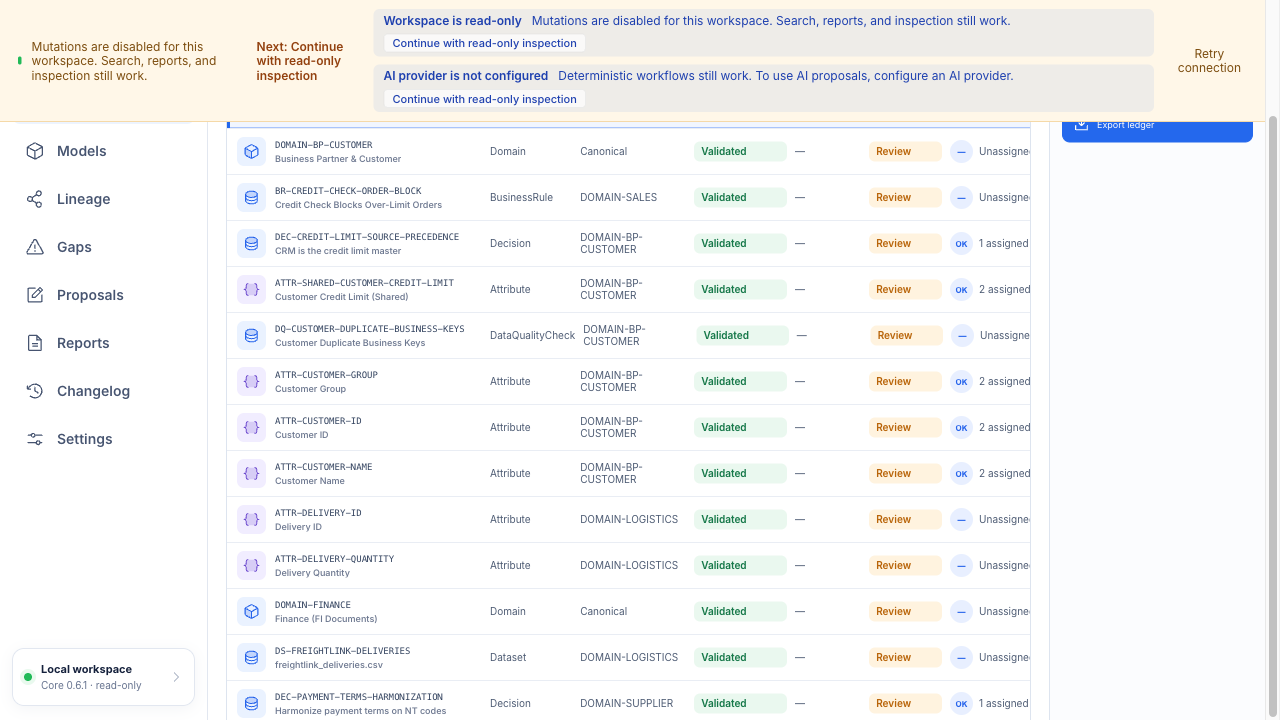
*The Workbench ledger reads ownership straight from the canonical files through the local API: attributes curated by the fictional stewards show their assigned owners, and the intentionally ownerless Logistics objects (ATTR-DELIVERY-ID, ATTR-DELIVERY-QUANTITY, DS-FREIGHTLINK-DELIVERIES) show Unassigned — the same ownership gap the owners report and readiness gates flag.*
Reproduce it locally
Use Python 3.11+ and a clean Core checkout. The script regenerates the deterministic CSV/XLSX inputs, validates the model, profiles the extracts, detects gaps, produces reports, traces impact, verifies the no-silent-mutation proposal behavior, and builds review artifacts.
python3.11 -m venv .venv
.venv/bin/python -m pip install -e '.[dev]'
bash scripts/demo_northstar_pilot.sh

# Start the same indexed canonical repository in the local Workbench.
.venv/bin/martenweave workbench --repo examples/northstar_mobility_pilot
The full command sequence, expected findings, deterministic data generator, and individual CLI commands are documented in the example README in Core.
Boundaries and next use
This is a demonstration fixture, not a template for automatically changing SAP or for handling personal data. Dataset profiles, gap reports, indexes, and bundles are generated artifacts. Markdown/YAML canonical files remain authoritative; AI can draft a proposal only when configured, deterministic validation runs first, and a human must review and approve any governed change.
For a real pilot, begin with one bounded business decision, approved-to-share representative evidence, named accountable reviewers, and an agreed clean-room data boundary. See the pilot project guide and the examples catalogue.