canonical files / deterministic validation / human-approved AI

Martenweave is the backend-first registry for governed data model truth.

Martenweave is a backend-first model registry that converts scattered model knowledge into validated, traceable, AI-ready model truth for migration, MDM, data governance, and support teams.

Backend-first. Human-approved. Built for real data model work.

Martenweave logo
ATTR Customer Group ATTR-CUST-SALES-GROUP
FEP SAP field endpoint FEP-S4-KNVV-KDGRP
PATCH AI proposes status: review

Use it when mappings drift across files.

Use it before mock loads and cutover checks.

Use it when AI needs validated context.

Use it for AMS knowledge continuity.

The problem

Model knowledge becomes useful when it is structured and validated.

Migration and governance teams work across spreadsheets, tickets, validation reports, datasets, decisions, and SAP context. Martenweave turns that scattered evidence into a canonical model layer that can be checked, searched, traced, and reviewed.

mapping workbook with unclear ownership ticket decision without field context validation report with no rule link handover note without model references mock-load finding disconnected from mappings AI prompt without structured truth

Registry core

A file-backed registry of model truth, not a chatbot or workflow platform.

Martenweave stores canonical model objects as files, validates them deterministically, builds disposable indexes, and gives humans a reviewable path for change.

modelops
$ modelops validate --repo examples/customer_bp_model
$ modelops build-index --repo examples/customer_bp_model --jsonl
$ modelops search "Customer Group" --repo examples/customer_bp_model
$ modelops trace ATTR-CUST-SALES-CUSTOMER-GROUP --repo examples/customer_bp_model
$ modelops impact FEP-S4-KNVV-KDGRP --repo examples/customer_bp_model
$ modelops propose-patch --from note.md --repo examples/customer_bp_model --dry-run
source Markdown + YAML

Canonical files are the model truth. Generated artifacts are rebuildable.

index SQLite + JSONL

Search, lineage, audit, and reports come from validated model state.

gate validators

IDs, types, references, and SAP context rules are checked before indexing.

AI patch proposals

AI drafts changes. Humans approve. No silent mutation.

What exists today

The core is already more than a landing-page promise.

martenweave-core is a Python backend and CLI package at version 0.4.0. It is local-first, file-based, and built for serious model work before any UI gets involved.

runtime

CLI, local API, MCP-ready backend

Use `modelops` from terminals, pipelines, local tooling, and agent workflows.

truth

Canonical Markdown + YAML

Model objects are Git-friendly files; generated indexes are disposable.

analysis

Validate, index, search, query, trace, impact

Run deterministic checks and inspect relationships across model objects.

readiness

Profiling, gaps, scorecard, ownership, audit

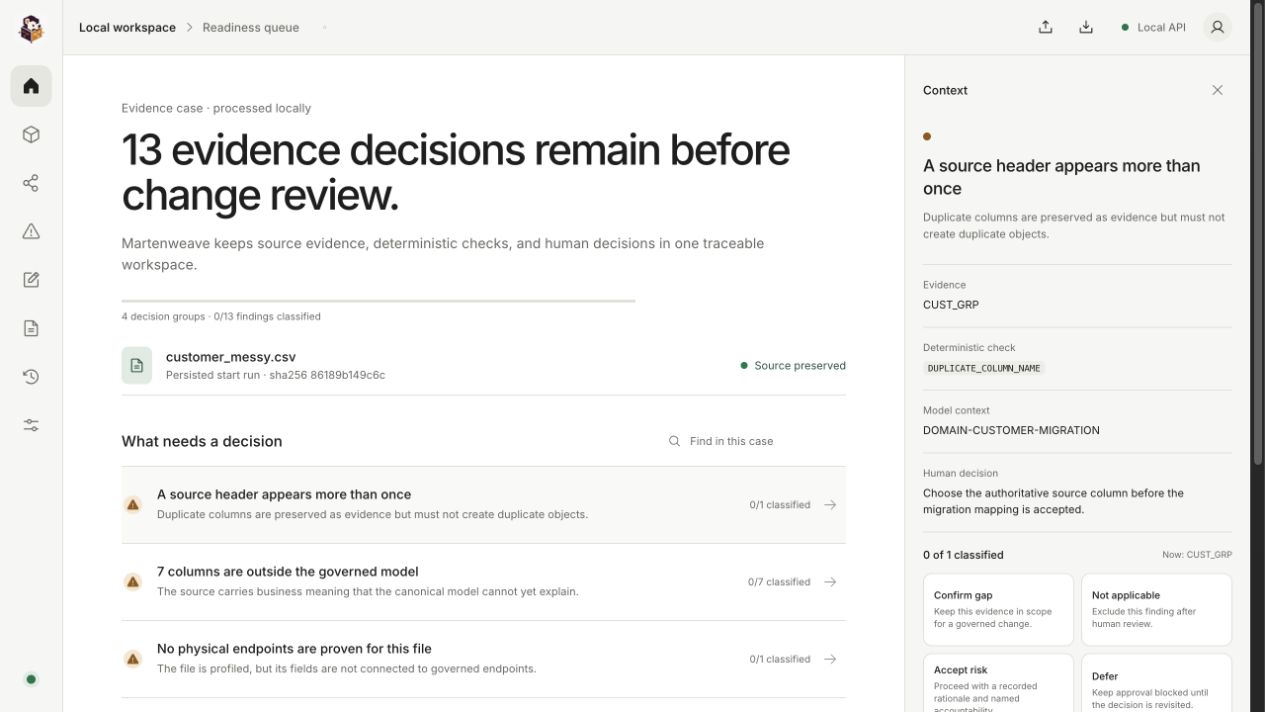
Move from raw datasets and validation noise to governed model readiness.

change

PatchProposal to ChangeRequest

AI-assisted or imported changes stay reviewable before canonical files change.

examples

Customer BP, Supplier Vendor, Generic Product

SAP scenarios are starter packs and demos, not the product boundary.

Quickstart

Clone, install, validate, index, inspect.

The core demo runs locally with Python 3.11+ and the bundled Customer / Business Partner example. No provider key or hosted service is required.

python -m venv .venv
.venv/bin/python -m pip install -e ".[dev]"
.venv/bin/modelops validate --repo examples/customer_bp_model
.venv/bin/modelops build-index --repo examples/customer_bp_model --jsonl
.venv/bin/modelops health --repo examples/customer_bp_model
.venv/bin/modelops search "Customer Group" --repo examples/customer_bp_model
.venv/bin/modelops impact FEP-S4-KNVV-KDGRP --repo examples/customer_bp_model
bash scripts/release_smoke.sh

What this proves

  • Canonical files parse and validate.
  • SQLite, search JSONL, and lineage JSONL rebuild from source files.
  • Search, trace, impact, health, gaps, and scorecards run on examples.
  • Patch proposals can be generated as dry-run review artifacts.
Read the full quickstart

What it does

A canonical model layer from scattered project artifacts.

Canonical model files

Markdown and YAML frontmatter objects become the durable source of truth.

Deterministic validation

Objects, IDs, types, SAP context, and references are checked before indexing.

Object/reference checks

Broken links, duplicate IDs, and wrong reference types are surfaced early.

Generated model index

SQLite, search JSONL, and lineage outputs are disposable and rebuildable.

Dataset/model gap detection

Compare sample datasets with expected endpoints before mock-load drama.

Impact analysis

Trace field and attribute consequences across mappings, usage, and lineage.

Evidence and lineage

Keep decisions, validation findings, fields, and mappings connected.

Patch proposal workflow

AI drafts reviewable changes instead of quietly rewriting model truth.

Human approval gates

Approved changes become change requests. The model does not mutate in the dark.

GitHub issue integration

Use issues for review, change tracking, and scenario feedback where it fits.

AI-ready model context

Give AI structured context it can reason over without pretending to be the source of truth.

How it works

The operating loop is explicit by design.

  1. 01Input artifacts
  2. 02Canonical model files
  3. 03Validation
  4. 04Generated index
  5. 05Gap and impact reports
  6. 06AI patch proposals
  7. 07Human approval
  8. 08Trusted model evolution

Use cases

For teams who need traceability before decisions become expensive.

SAP migration model registry

Problem: Scope, fields, and rules drift across files.

Helps: Domains, contexts, fields, and mappings stay connected.

Value: Fewer truth disputes during mock loads and cutover planning.

MDM rule and ownership layer

Problem: Ownership is social, not operational.

Helps: Rules, attributes, and decisions become referenceable.

Value: Governance teams discuss change with evidence.

Customer / BP mapping control

Problem: Field behavior differs by context and system.

Helps: Attribute usage and SAP context rules stay explicit.

Value: Cleaner mapping control without spreadsheet archaeology.

Supplier / Vendor model control

Problem: Supplier and vendor terms blur across systems.

Helps: Business meaning is separated from physical fields.

Value: Better handoffs between process, data, and migration teams.

Dataset gaps before mock load

Problem: Missing fields appear late, after load planning has begun.

Helps: Profiled datasets are compared with expected endpoints.

Value: Earlier remediation and less validation ping-pong.

Validation report triage

Problem: Reports show failures without model context.

Helps: Findings link back to fields, rules, mappings, and decisions.

Value: Triage becomes evidence-led, not inbox-led.

AMS knowledge continuity

Problem: Support inherits decisions but not the reasoning.

Helps: Canonical history keeps context after go-live.

Value: Less knowledge loss between delivery and support.

Governance impact analysis

Problem: Small field changes can ripple downstream.

Helps: Impact traversal shows connected objects and lineage.

Value: Better change decisions before downstream teams discover them.

AI-assisted maintenance

Problem: AI can help, but unchecked changes are not governance.

Helps: AI proposes patches that validators and humans review.

Value: Faster maintenance without surrendering control.

Why not just...

Excel, Confluence, tickets, and AI assistants still have jobs. This is a different job.

Excel

Stores fragments. Useful fragments, but weak as governed model truth.

Confluence

Stores explanations. Helpful, but it does not validate model references.

Tickets

Store disputes, approvals, and delivery history. They are not a model layer.

AI assistants

Can summarize and draft. It should not quietly redefine truth.

Martenweave

Stores validated model truth and makes it operational through checks, indexes, reports, lineage, and reviewable changes. It is not SAP-certified or SAP-affiliated; SAP is a target scenario and domain-pack context, not an official partnership claim.

AI proposes.

Validators verify.

Humans approve.

AI philosophy

AI is useful. Silent mutation is not.

Martenweave does not ask AI to be the source of truth. That would be brave in the same way any unreviewed model change is risky. AI proposes changes. Validators check them. Humans approve them.

  • Suggest patches from notes, reports, and issue context.
  • Extract evidence and draft issues for review.
  • Explain likely impact from structured model context.
  • Keep deterministic validators as the gate.
  • Prevent silent model mutation.

Architecture

Backend-first so model truth is independent of any one interface.

The canonical model files are the truth. Generated indexes are acceleration. Reports are evidence. Proposals are reviewable. Nothing important changes silently.

source

Canonical files

Markdown and YAML objects in a repository.

gate

Deterministic validation

IDs, types, references, and SAP context rules.

acceleration

Disposable indexes

SQLite, JSONL search documents, and lineage exports.

value

Reports and workflows

Health, gaps, impact, audit, issues, and review queues.

Roadmap

A practical roadmap for a trustworthy model layer.

Phase 1

Core registry

  • Init model repository
  • Load canonical model files
  • Validate objects and references
  • Build generated index
Phase 2

Model intelligence

  • Dataset/model gap detection
  • Impact analysis
  • Lineage reports
  • Validation report linking
Phase 3

AI-assisted workflows

  • Evidence extraction
  • Patch proposals
  • GitHub issue creation
  • Human approval gates
Phase 4

Starter packs

  • SAP Business Partner / Customer starter pack
  • Supplier / Vendor starter pack
  • Data governance templates
  • AMS knowledge continuity scenarios
Phase 5

Workbench

  • Optional lightweight UI
  • Review queues
  • Impact explorer
  • Model health dashboard

Open source

Contribute real scenarios and focused issues.

Martenweave is early and intentionally backend-first. Feedback is most useful when it comes with real migration, MDM, data quality, governance, or AMS scenarios.

Useful contributions include synthetic examples, failing commands, validation gaps, and domain-pack scenarios.

Founder contact

Built by Dzmitryi Kharlanau

Dzmitryi works around SAP AMS, master data, SD/MM support, migration context, and AI-assisted operational knowledge workflows.

Martenweave is his open-source attempt to make SAP model knowledge more traceable, validated, and useful for humans and AI.

Open to feedback, practical SAP MDM / migration readiness scenarios, and focused pilot conversations around model governance, dataset gaps, validation evidence, and AMS knowledge continuity.